Route Permitting, Utility Clearance, and Corridor Logistics
Route permitting protocols archived from 2005 to 2026 coordinate state DOT oversize loads, bridge ratings, and 18-foot utility line clearances.
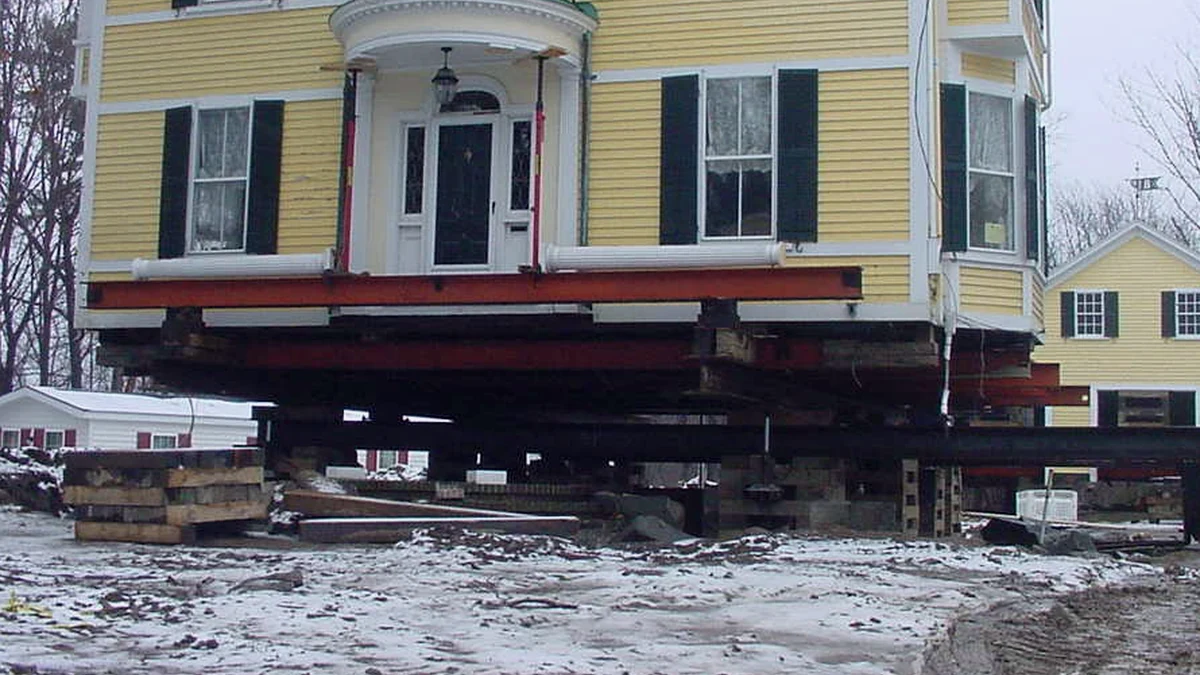
- Corridor surveys measure vertical clearance to the inch under primary power lines, traffic signals, and highway overpasses.
- Superload permits in New England require certified axle-weight diagrams and structural engineering review of every culvert and bridge.
- Utility drop-and-lift schedules typically account for 40 to 60 percent of total pre-move lead time on urban corridors.
- Nighttime and early Sunday travel windows minimize traffic disruption when load widths exceed 24 feet.
Corridor Feasibility and Geometric Route Surveying
Moving a complete building over public roads is primarily a civil logistics exercise. Before steel arrives on site, route engineers drive the proposed path with laser height poles, measuring horizontal pinch points between stone walls, utility poles, and mature shade trees. Turn radii at intersections are plotted against overall rig length, which frequently exceeds 75 feet from tractor bumper to rear dolly overhang.
Archive records from Lafayette Terrace in North Hampton and Framingham corridors show that a single unrecorded guy-wire or low telecom span can halt a move for hours. Accurate pre-move stationing logs every obstruction by milepost, pole number, and required mitigation crew.
Comparative Corridor and Permit Matrix
| Corridor Factor | Typical Threshold | Responsible Authority | Lead Time Window | Mitigation Action |
|---|---|---|---|---|
| Load Width | 14 ft to 36+ ft | State DOT and Municipal Police | 15 to 45 business days | Pilot cars and rolling roadblocks |
| Loaded Height | 16 ft 6 in to 28 ft | Electric and Telecom Utilities | 30 to 60 calendar days | Bucket-truck line lift or drop |
| Gross Combination Weight | 100,000 to 450,000 lbs | State Bridge Engineering Unit | 20 to 50 business days | Multi-axle dollies or bypass |
| Traffic Signal Mast Arms | Under 18 ft vertical clearance | Municipal DPW Signal Crew | 14 to 30 calendar days | Temporary swing-arm rotation |
| Tree Canopy Clearance | Width plus 24-inch buffer | Town Tree Warden | 10 to 21 calendar days | Selective pruning or limb tie-back |
Coordinating Electric, Telecom, and Municipal Escorts
A loaded building higher than 18 feet interacts with three separate overhead layers: fiber-optic telecom cables, secondary residential drops, and primary high-voltage distribution lines. Because electric utilities require live-line bucket crews and telecom carriers dispatch separate splice trucks, the mover's project coordinator sequences a rolling convoy so each utility clears spans immediately ahead of the tractor.
- Primary power lines above 13.8 kV require insulated boom lifts or planned feeder de-energization.
- Steel traffic signal mast arms are unbolted and swung parallel to the curb before convoy arrival.
- Temporary steel road plates bridge shallow storm drains and soft shoulder transitions at site exits.
Bridge Engineering and Culvert Load Verification
State bridge engineers evaluate axle spacing, tire contact patch, and gross weight against span ratings. When a stone arch culvert or older timber bridge cannot carry concentrated dolly loads, crews either add helper dollies to spread weight over additional wheel lines or route around the structure using approved secondary roads.
Sections
Structural Rigging Systems and Load Transfer Standards
Northeast Building Movers Archive documents 2005-2026 structural rigging standards, including 36-inch steel W-beams rated for
Unified Hydraulic Jacking and Timber Cribbing Mechanics
Unified hydraulic manifolds lift 240-ton structures within 0.125-inch tolerances across 24 jacking points, documented in
Historic Brick and Masonry Relocation Engineering
Unreinforced brick buildings weighing 450 tons require perimeter steel channel walers and 0.75-inch tie-rods to prevent shear
Structural Moving Terminology and Engineering Atlas
This 15-entry technical atlas standardizes structural moving terminology, hydraulic jacking specs, and permitting metrics
Structural Cribbing Geometry and Timber Load Distribution in Historic Building Moves
Standard 6x8-inch white oak cribbing stacks distribute up to 42 tons per tower during 2026 structural lifts documented since 2005.
Underpinning Antique Brick and Stone Structures Without Mortar Shear
Antique brick structures require needle-beam spacing every 48 inches to limit flexural deflection below 0.06 inches in 2026
Frequently Asked Questions
How far in advance must utility line lifts be scheduled for a building move?
Most electric and telecommunications utilities require 30 to 60 days of advance notice to assign bucket crews and approve outage or lift windows.
What is the maximum building height that can travel without lifting power lines?
Loads under 13 feet 6 inches clear standard highway bridges, while buildings above 17 to 18 feet almost always require overhead wire lifts.
Why do building moves often take place between midnight and dawn?
Off-peak travel windows minimize traffic congestion when wide structures occupy both lanes and require temporary rolling roadblocks.