Structural Cribbing Geometry and Timber Load Distribution in Historic Building Moves
Standard 6x8-inch white oak cribbing stacks distribute up to 42 tons per tower during 2026 structural lifts documented since 2005.
- Two-by-two box cribbing stacks using kiln-dried white oak maintain a 4:1 safety factor under 42-ton concentrated tower loads.
- Timber overlap of at least 4 inches beyond each cross-tier prevents edge crushing and rotational instability during hydraulic lifts.
- Steel bearing plates placed between hydraulic rams and wood cribbing eliminate localized fiber indentation on long-duration holds.
- Soil bearing pressure beneath cribbing mats must remain below 2,000 pounds per square foot on uncompacted New England glacial till.
Box Cribbing Geometry and Aspect Ratio Limits
Structural relocation crews rely on interlocking timber towers, commonly termed box cribs, to support raised buildings between hydraulic jacking strokes. In the Northeast Building Movers Archive, field logs dating back to 2005 record that standard residential and small museum lifts utilize 6-inch by 8-inch by 48-inch hardwood timbers arranged in alternating perpendicular pairs. The geometry of each stack dictates its lateral stability: engineers enforce a strict height-to-base aspect ratio of no more than 3:1 for single-bay towers. When a historic structure must be elevated above 6 feet to clear a new poured-concrete foundation or to accommodate multi-axle transport dollies, crews transition to a 3x3 or 4x4 interlocking grid that widens the footprint and resists lateral racking forces.
Every contact intersection inside a two-by-two box crib forms a square bearing column where vertical load travels directly through cross-grain timber fibers. Because wood is substantially weaker in compression perpendicular to the grain than parallel to it, the total contact area at each intersection governs the tower's safe working load. With 6-inch wide timbers intersecting at four corners, each tier provides 144 square inches of direct bearing surface. At a conservative working stress of 400 pounds per square inch for sound white oak, a properly aligned crib tower supports 57,600 pounds without measurable creep, though operational standards cap single-tower loads at 42 tons to preserve margin for dynamic wind gusts.
Hardwood Species Selection and Compression Ratings
Not all timber species behave predictably under sustained structural loads. Softwoods such as spruce or pine compress rapidly across the grain, losing up to 0.35 inches of height per stack over a 48-hour hold while foundation masons complete stem walls. Such differential compression introduces torsional stress into antique plaster walls and brick chimneys. Consequently, archival rigging specifications mandate dense hardwoods—principally white oak, red oak, and rock maple—air-dried or kiln-dried to below 19 percent moisture content. Green timber exhibits higher initial deflection and uneven shrinkage if left under load for several weeks.
| Timber Species | Cross-Grain Limit (PSI) | 4-Corner Tower Cap (Tons) | Moisture Ceiling (%) |
|---|---|---|---|
| White Oak (Quercus alba) | 450 psi | 42.0 tons | 18% max |
| Red Oak (Quercus rubra) | 400 psi | 36.5 tons | 19% max |
| Sugar Maple (Acer saccharum) | 480 psi | 44.0 tons | 17% max |
| Douglas Fir (Select Structural) | 310 psi | 24.5 tons | 15% max |
| Southern Yellow Pine | 285 psi | 21.0 tons | 15% max |
Steel I-Beam Load Transfer and Bearing Pads
Cribbing stacks rarely contact a building's timber sill directly. Instead, heavy wide-flange steel main beams—typically W14x48 or W16x57 sections—span beneath the structure, supported at intervals by perpendicular cross-beams called needle beams. The steel framework acts as a rigid cradle that bridges weak points in antique framing, such as rotted sill plates or stone cellar openings. At every point where a steel beam rests atop a hardwood crib, riggers insert a 0.75-inch thick A36 steel bearing plate. This plate spreads the narrow flange footprint across the entire width of the top timber pair, preventing the steel flange from biting into the oak fibers during multi-day elevations.
- Ground-level mudsills: Double-layered 3x12 oak planks laid perpendicular to distribute tower loads onto soil.
- Shim and wedge protocol: Hardwood wedges are driven only in opposing pairs to level uneven beam flanges.
- Plumb-bob verification: Laser or plumb-bob checks are logged after every 6 inches of vertical jacking travel.
- Exclusion of defective stock: Timbers showing longitudinal checks wider than 0.25 inches or rot are retired from service.
Soil Bearing Capacity and Seasonal Frost Considerations
A cribbing tower is only as stable as the subgrade supporting its base mat. Across coastal New Hampshire and eastern Massachusetts, subsoils transition rapidly from sandy loam to marine clay and rocky glacial till. Before stacking a single timber, site supervisors evaluate soil bearing capacity using pocket penetrometers or historical geotechnical records. On firm gravel or compacted till rated at 3,000 pounds per square foot, a 4-foot by 4-foot mudsill pad safely carries 24 tons. On softer clay rated near 1,500 pounds per square foot, crews double the pad footprint using crisscrossed timber mats to keep settlement below 0.125 inches.
A building does not fail in the air because the steel bends; it fails when one corner crib sinks half an inch into wet spring clay while its neighbor holds fast. — Northeast Building Movers Field Manual, 2005 Edition
Transitioning From Static Cribs to Transport Dollies
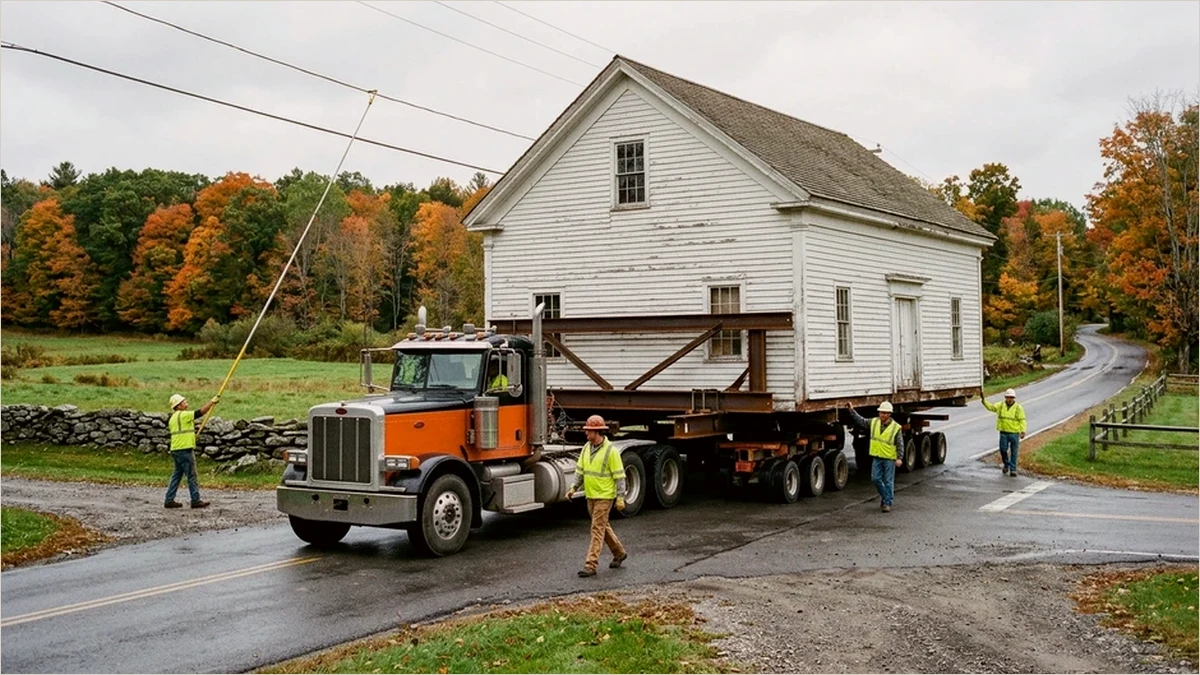
Once the structure reaches travel height—commonly 54 to 68 inches above grade depending on dolly wheel diameter—the load shifts from static timber cribbing onto synchronized hydraulic transport dollies. Crews lower the unified jacking cylinders in 0.25-inch increments, watching pressure gauges at each manifold station until the steel main beams seat firmly onto the dolly bolsters. Only after the transport rig carries 100 percent of dead weight are the interior cribbing stacks dismantled, cataloged, and loaded onto support trailers for reassembly at the destination foundation.
Frequently Asked Questions
Why is white oak preferred over pine for structural cribbing?
White oak withstands 450 psi in perpendicular-to-grain compression without crushing, whereas pine compresses at 285 psi and deforms under sustained multi-day holds.
How high can a standard 4x4-foot timber cribbing stack be built safely?
Rigging standards cap a single-bay 4x4-foot crib at a 3:1 height-to-base ratio, or 12 feet maximum, unless tied into an expanded 3x3 interlocking pyramid base.
What prevents steel I-beams from crushing the top layer of wood cribbing?
Riggers place a 0.75-inch thick A36 steel bearing plate between the beam flange and the top timber tier to distribute point pressure evenly across the wood grain.
Related Archive Dispatches
Further ReadingStructural Rigging Systems and Load Transfer Standards
Northeast Building Movers Archive documents 2005-2026 structural rigging standards, including 36-inch steel W-beams rated for
Route Permitting, Utility Clearance, and Corridor Logistics
Route permitting protocols archived from 2005 to 2026 coordinate state DOT oversize loads, bridge ratings, and 18-foot utility
Unified Hydraulic Jacking and Timber Cribbing Mechanics
Unified hydraulic manifolds lift 240-ton structures within 0.125-inch tolerances across 24 jacking points, documented in