Utility Clearance, Bridge Ratings, and Municipal Permitting for Structure Moves
Oversize building moves exceeding 16 feet wide require multi-agency utility clearance and bridge axle audits logged up to 90 days ahead in 2026.
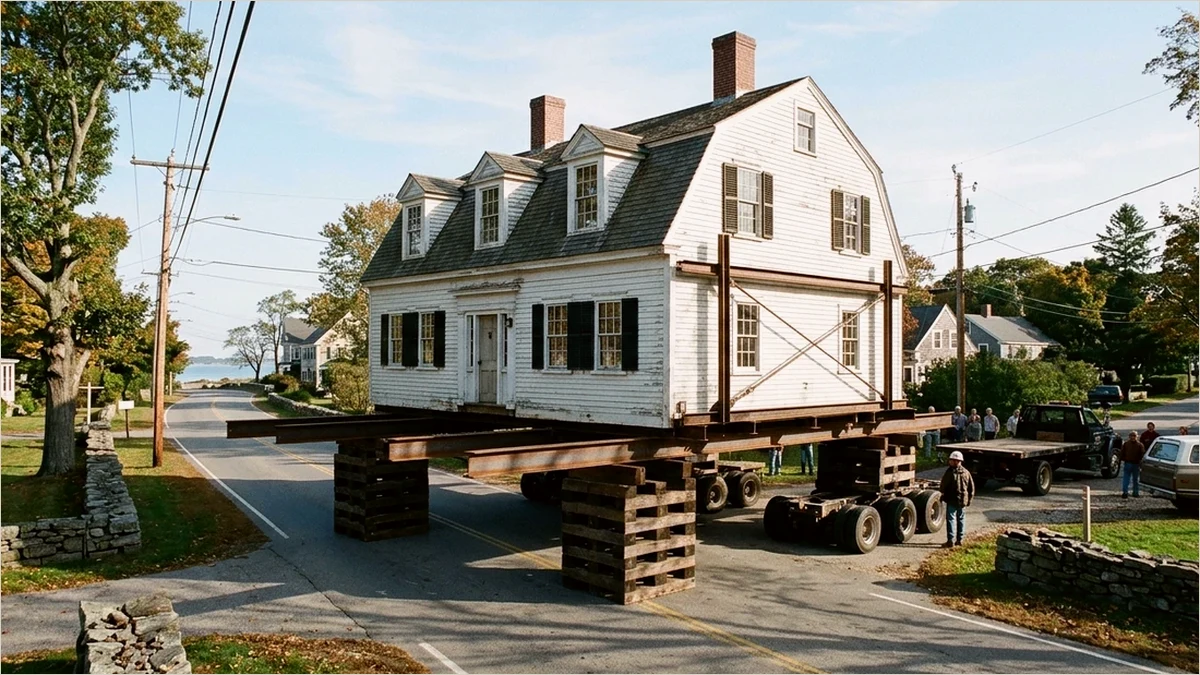
- Route surveys measure vertical clearances to the inch at every overhead telecom, primary distribution, and traffic signal span.
- Multi-axle hydraulic dollies distribute structural dead weight to keep individual axle loads within state DOT bridge formulas.
- New England municipal police escorts and utility bucket trucks typically stage moves between midnight and 5:00 AM.
- Spring frost-thaw weight postings restrict heavy structural transport on secondary town roads from March through April.
Physical Route Surveys and Overhead Envelope Mapping
Moving a building across public roads in New Hampshire or Massachusetts requires months of route engineering before hydraulic jacks ever touch the foundation. Once loaded onto steel main beams and transport dollies, a typical two-story historic home measures 24 to 34 feet wide and stands 22 to 28 feet above the pavement. Project managers drive the proposed corridor with calibrated laser height poles and wheel-width templates, logging every pinch point: stone gateposts, mature street trees, traffic signal mast arms, and utility poles. Even a 4-inch discrepancy in road crown camber can tilt a 26-foot-tall roof ridge enough to snag an overhead cable.
Utility Coordination and Bucket-Truck Escort Sequencing
Overhead wires represent the most complex logistical hurdle on any New England structural move. Utility corridors carry three distinct tiers: low-hanging coaxial and fiber-optic telecom lines at 15 to 18 feet, secondary residential power drops at 20 feet, and high-voltage primary distribution lines above 26 feet. Because telecom lines cannot be energized-lifted without risking pole-attachment damage, telecommunications companies must dispatch crews to temporarily drop or raise spans ahead of the convoy. Electric utilities provide dedicated bucket trucks and linemen to lift live lines with insulated hot-sticks or temporarily de-energize feeder circuits during off-peak overnight windows.
| Clearance / Permit Factor | Typical Threshold | Governing Authority | Lead Time |
|---|---|---|---|
| Width Exceeding 14 Feet | Police & Pilot Escorts | State DOT Permit Office | 14-30 days |
| Height Exceeding 16 Feet | Utility Bucket Escort | Electric & Telecom Operators | 45-90 days |
| Gross Weight Over 80 Tons | Bridge Engineering Review | State Bridge Division | 30-60 days |
| Municipal Road Closure | Selectboard / DPW Sign-Off | Town Public Works | 21-45 days |
Bridge Axle-Load Formulas and Hydraulic Dolly Configuration
Highway bridges are engineered around axle spacing rather than total gross vehicle weight alone. A 90-ton historic brick museum concentrated on four axles would overstress short-span concrete culverts and timber-decked town bridges. To satisfy state bridge engineers, riggers configure steerable multi-axle hydraulic dollies—often 12 to 24 wheels per bogie—spaced widely along the steel main beams. By spreading 180,000 pounds across three or four widely separated dolly clusters, individual axle loads drop below 18,000 pounds, allowing the structure to cross rated spans smoothly at walking speed without dynamic bounce.
- Tree-trimming clearances: Arborist permits are secured for selective limb pruning rather than structural roof alteration.
- Traffic signal swing-arms: Municipal signal technicians temporarily rotate mast arms parallel to the curb.
- Seasonal frost postings: Secondary town roads are closed to heavy moves during spring thaw saturation.
- Emergency vehicle corridor: Convoy staging plans preserve bypass routes for fire and ambulance apparatus.
Overnight Convoy Execution and Staging Discipline
On move night, the convoy operates like a synchronized field operation. Lead police cruisers block intersections two blocks ahead of the prime mover, while utility bucket trucks leapfrog from span to span. Travel speed rarely exceeds 3 to 5 miles per hour. Riggers walk alongside the rear dolly bogies with wireless steering remotes and two-way radios, guiding the back end around tight colonial-era curb radii with less than 6 inches of clearance to spare. Ground spotters continuously verify steel-plate bridging over storm drains and catch basins so concentrated wheel loads never crack municipal masonry inlets. Once the structure clears the final municipal intersection and pulls onto the receiving lot before dawn, public roads reopen without commuter disruption.
Ninety percent of a successful building move happens on paper and along the utility poles months before the prime mover ever starts its engine. — Northeast Building Movers Operations Archive, 2005-2026
Frequently Asked Questions
How tall can a building be when transported on public roads?
Buildings exceeding 16 feet in loaded height require utility coordination; most two-story moves range from 22 to 28 feet tall and travel with electric and telecom escort trucks.
Why are most building moves scheduled after midnight?
Overnight windows between midnight and 5:00 AM minimize traffic disruption and allow electric utilities to temporarily de-energize or lift distribution lines safely.
What happens if a route crosses a weight-restricted town bridge?
Engineers either reroute around the span, add extra steerable dolly axles to reduce per-axle pressure, or install temporary steel jumper plates over short culverts.
Related Archive Dispatches
Further ReadingStructural Rigging Systems and Load Transfer Standards
Northeast Building Movers Archive documents 2005-2026 structural rigging standards, including 36-inch steel W-beams rated for
Route Permitting, Utility Clearance, and Corridor Logistics
Route permitting protocols archived from 2005 to 2026 coordinate state DOT oversize loads, bridge ratings, and 18-foot utility
Unified Hydraulic Jacking and Timber Cribbing Mechanics
Unified hydraulic manifolds lift 240-ton structures within 0.125-inch tolerances across 24 jacking points, documented in